
A Yakut knife is easy to maintain, but it is sharpened differently from an ordinary knife. The blade has a convex side and a flat side with the hollow (dol). You sharpen from the flat side, laying it whole on the stone; the convex side gets no bevel — its burr comes off with light passes on a strop. The one mistake to avoid is grinding the asymmetric blade into a symmetric edge. Here’s the whole routine, from stone to storage.
How do you sharpen a Yakut knife?
There is no angle to set: the flat side and the convex side meet at the edge in the geometry the smith gave them. You keep that geometry by working from the flat side. The routine:
- Flat side down, the whole side on the stone. Lay the side with the dol completely flat on the stone and draw the blade along it, over the full length of the edge, with even pressure. Don’t lift the spine to “find an angle”. Keep going until a fine burr rises along the whole edge on the convex side.
- No bevel on the convex side. Never grind a bevel on the convex side — that extra facet (the Sakha call it tilekh) spoils the geometry. Take the burr off very carefully, with a few light passes on a leather strop, following the curve of the convex side and without pressure.
- Coarse to fine. Repeat on each stone, from coarser to finer grit.
- Finish on a strop. A leather strop with polishing paste: the flat side laid flat, the convex side with light passes that follow its curve. Pull the edge away, spine first.
For a quick touch-up, a micro-bevel from the flat side is acceptable, at no more than 6–7°. Some people sharpen from the convex side instead: it feels more familiar, but the knife cuts worse and the geometry drifts.
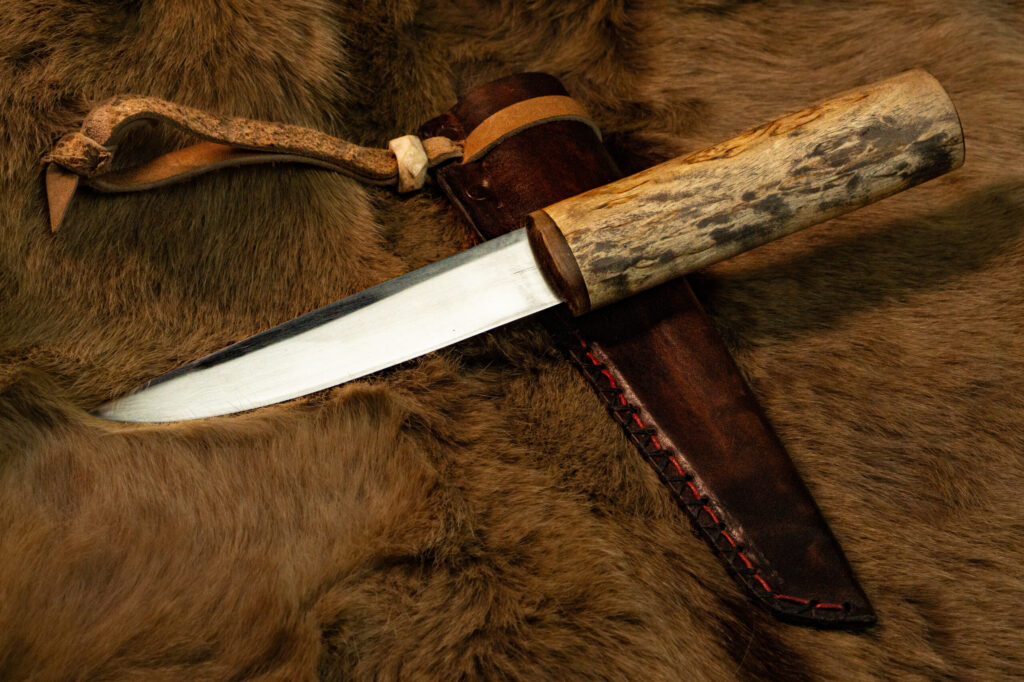
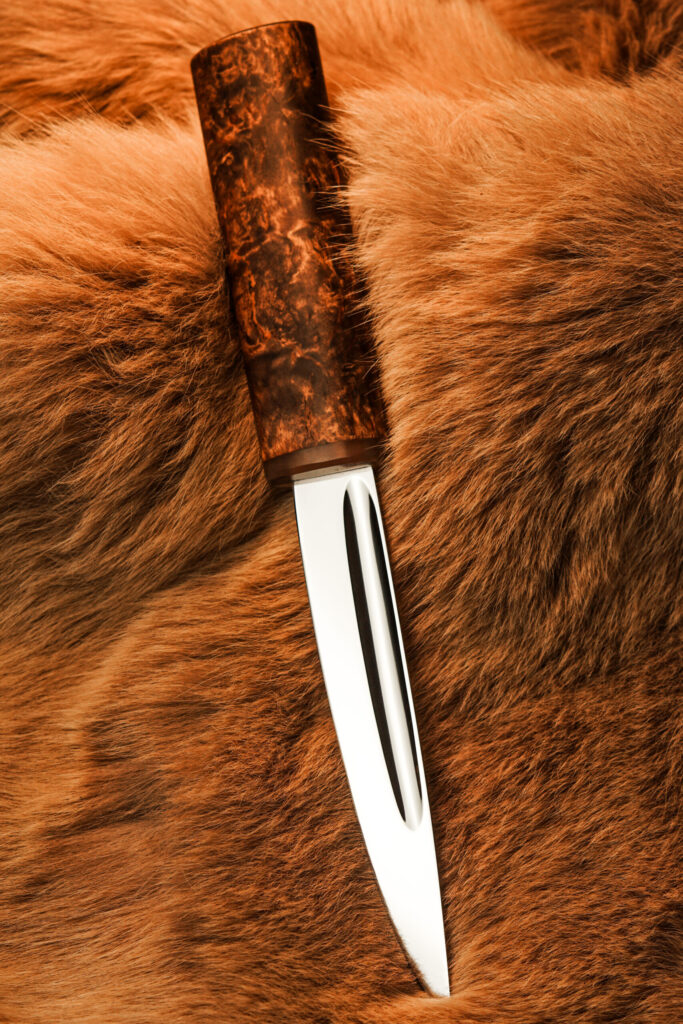
The golden rule: preserve the asymmetry. If you sharpen both sides equally like a Western knife, you erase the geometry that makes a Yakut knife cut the way it does.
What stones or tools do you need?
Keep it simple: a medium and a fine whetstone (water or oil stone) cover almost everything. A medium grit (~400–1000) restores a dull or nicked edge; a fine grit (~3000–6000) refines it. A leather strop with a little polishing paste is the finishing touch, and between sharpenings a few passes on the strop are often all you need to bring the edge back. Stones should be flat and wide enough for the whole flat side of the blade to lie on them. Avoid powered grinders, pull-through “V” sharpeners and guided angle systems — all of them are built for symmetric edges and will destroy the asymmetric grind.
How often should you sharpen it?
Less than you’d think. For everyday cutting, strop the edge regularly and only go to the stones when stropping no longer brings back the bite — for many users that’s a few times a year, not a few times a month. Sharpen sooner if you’ve cut something abrasive (cardboard, frozen material), nicked the edge, or notice it crushing rather than slicing. Every trip to the stone removes metal, so light, frequent stropping keeps the grind intact longest.
How do you stop a Yakut knife from rusting?
It depends on the steel. 40Kh13 is stainless but not rust-proof. Kh12MF is semi-stainless: it rusts slowly but can spot if neglected. 65G is carbon steel: it rusts and darkens. The dark film that builds up on 65G is not protection — wipe the blade dry after every use and keep a thin film of oil on it. (More on each grade in Yakut knife steel.)
For every steel, the rules are the same:
- Dry before the sheath. A damp blade in a sheath is the most common cause of rust, even on stainless.
- Rinse after acid. After lemon, onion, vinegar or fish, rinse with warm water and dry at once — acid left overnight starts real rust fastest.
- No dishwasher. Heat, water and detergent damage both the steel and the wooden handle. Hand-wash and dry.
- Oil thinly. One drop of food-safe oil (mineral or camellia) on a cotton pad, wiped over the whole blade. A thick coat only collects dust. Don’t use motor oil or WD-40 on a blade that touches food.
If light red surface rust appears, take it off straight away: a little metal polish on a damp cloth, or 0000 steel wool with a drop of oil, then rinse, dry and oil. Steel wool will scratch a polished finish. Deep pitting means steel has been lost — write to us before you try to grind it out.
How should you store it?
For a few days, the sheath is fine if the blade went in dry. For two weeks or more, oil the blade thinly and keep the knife in a dry room — ideally out of the sheath, or at least with the blade bone-dry and oiled. Never seal it in a plastic sleeve: it traps moisture. A small silica-gel packet helps in a display case.
How do you care for the birch handle and sheath?
The birch handle is wood, so treat it like good wood: don’t soak it, and once or twice a year rub in a little boiled linseed oil, tung oil or beeswax paste, leave it for 30 minutes and wipe off the excess. That stops it drying and cracking in heated indoor air. If the handle gets wet, let it dry at room temperature, never by a heater — heat splits wood. The horn or antler bolster only needs to be kept dry. If the sheath gets wet, let it air-dry fully, away from heat, and treat the leather occasionally with conditioner.
Not sure which steel your knife is, or how to deal with a rust spot? Write to info@muusknife.com.
Frequently asked questions
Is a Yakut knife hard to sharpen?
No — it’s straightforward, just different. Lay the flat side with the dol whole on the stone and sharpen from there; on the convex side, grind no bevel — just take the burr off with light strop passes. Avoid pull-through sharpeners and powered grinders.
What angle do you sharpen a Yakut knife at?
You don’t set one. The flat side lies whole on the stone, so the edge keeps the angle the smith built into the grind, and the convex side gets no bevel. The only angle you ever choose is an occasional micro-bevel from the flat side for a quick touch-up, no more than 6–7°.
Do I need to oil a stainless Yakut knife?
Less often than carbon steel, but yes — wipe it dry after use and oil it occasionally. Stainless resists rust but isn’t rust-proof, especially if stored damp in a sheath.
Will the carbon blade rust?
Yes, 65G rusts if left wet, and it darkens with use. The dark film does not protect it. Wipe it dry after every use and keep it lightly oiled. See choosing a Yakut knife for how the steels compare.
Our knives are forged by hand by smiths of the Sakha Republic; MUUS brings their work to you from Yakutsk. Explore the collection »
Hand-forged Yakut knives from Sakha smiths
Forged by master smiths of the Sakha Republic; MUUS sells their work online and in our shop in Yakutsk — from working models to collector pieces.
Shop Yakut knives