
Looking to buy one? In stock from $139. Shop Yakut knives →
Stroganina (Russian: строганина, from strogat’, “to plane” or “to shave”) is a dish of raw, frozen fish shaved into thin, curling ribbons and eaten while still frozen, dipped in a mix of salt and black pepper. It is the signature winter dish of Yakutia and of other peoples of northern Siberia, where deep-winter temperatures fall below −40 °C and a fresh-caught fish freezes solid within minutes on the ice. Here is what it is, how it’s eaten, how to make it safely — and why it is traditionally cut with a Yakut knife.
What is stroganina?
Stroganina is frozen fish (and sometimes frozen meat or liver) planed into long, thin shavings and served frozen — never cooked, never marinated. The cold itself is the preparation. The classic fish is chir (broad whitefish); muksun, nelma and omul, all whitefish of the northern rivers, are the other traditional choices. They are firm, oily fish that curl cleanly when shaved thin and taste rich and clean. A frozen shaving melts on the tongue within seconds, which is why it is eaten fast.
How is stroganina eaten — and when?
The shavings are piled on a chilled plate and eaten straight away, before they thaw. Each one is dipped in makanina — coarse salt mixed with black pepper — and that is the whole seasoning. Stroganina is winter food: it belongs to the cold months, the season of chir and the other whitefish caught under the ice, when the freeze is the pantry. In Yakutia it is everyday winter food and a centrepiece of festive tables.
How is stroganina made?
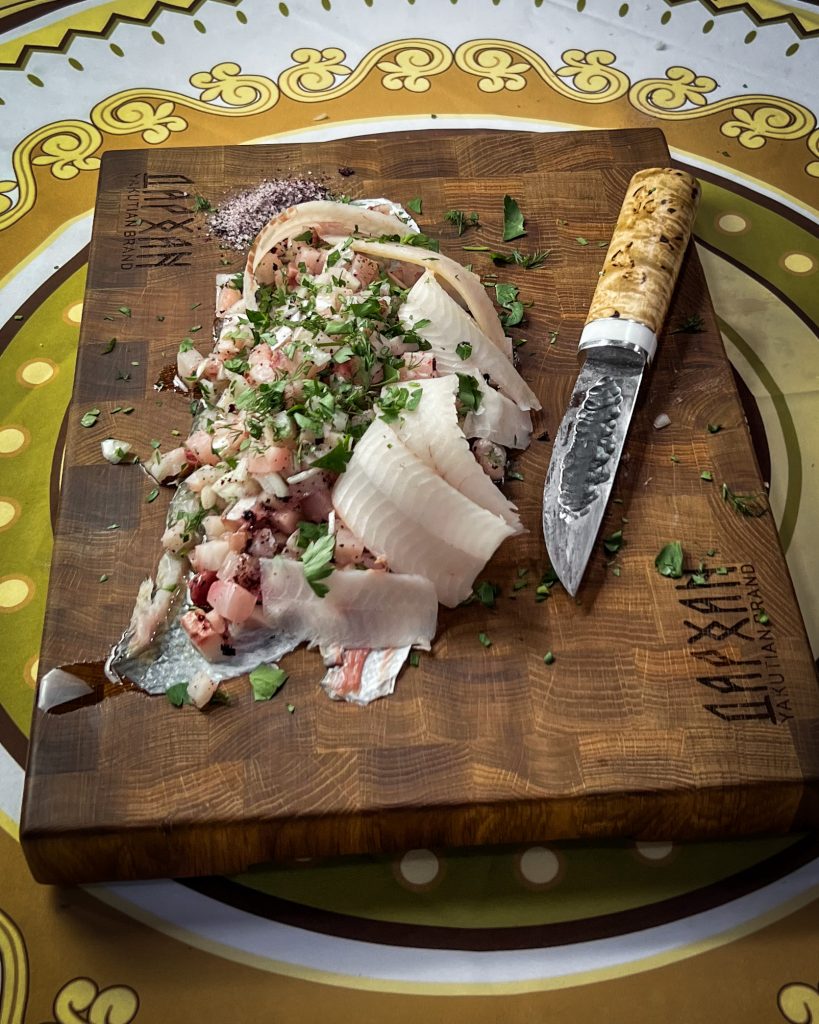
The method is simple; the discipline is keeping everything frozen. Start with a fish that is frozen solid and whose freezing is confirmed to make raw fish safe (see the safety question below). Working fast so it never thaws, stand the fish upright, tail up, or brace it firmly, and strip the skin away in sections. Then plane the flesh in long strokes, drawing the blade down the body from tail toward head to peel off thin, curling ribbons. The fish is braced on a wooden balturmas board, which holds it steady and protects both the edge and the table. Lay the shavings on a chilled plate and serve at once, with makanina alongside. The only “ingredients” are a solidly frozen fish, a very sharp blade and cold hands working fast.

Why is the Yakut knife the tool for stroganina?
Because frozen flesh sticks. Drag an ordinary symmetric blade through a frozen fish and the flesh clings to both faces of the steel, so the blade drags and the shaving tears instead of curling. The Yakut knife has a wide, shallow hollow — the dol — on one face only, and that hollow breaks the suction, so the blade releases cleanly and planes long, even ribbons. Slicing frozen fish is not a novelty use of a Yakut knife — it is one of the jobs the grind was made for, alongside dressing game and shaping wood in the cold. (See what makes a Yakut knife different.)
Which knife — and board — do you need for stroganina?
Two tools do the whole job. First, a Yakut knife with a true asymmetric grind: stiff, very sharp and — because the blade is “handed” — ground for your dominant hand. A dedicated stroganina knife has a long, thin blade of 19–22 cm, longer than an everyday knife, so each stroke takes a full-length ribbon. A natural, guardless handle helps you keep a secure grip with cold fingers. Second, a balturmas stroganina board — the traditional Yakut wooden board that pins the frozen fish steady while you plane it, so you cut with control instead of chasing a sliding fish across the counter. If you’re choosing your first blade, our guide to choosing a Yakut knife walks through size, steel and hand.
How do you care for the knife after cutting frozen fish?
Frozen-fish work is wet work: condensation forms on cold steel the moment you bring it indoors. Wipe the blade dry right away, before it goes back in the sheath, and never put it in a dishwasher. The full routine — oil, rust, sharpening the asymmetric edge — is in How to Sharpen and Care for a Yakut Knife.
Frequently asked questions
Is stroganina safe to eat?
It is raw fish, so safety depends on how it was frozen — and a home freezer is not enough. Russian sanitary rules SanPiN 3.2.3215-14 (table 3) set the freezing regimes that kill opisthorchid larvae, a parasite of freshwater fish: −40 °C in the thickest part of the fish for 7 hours, −35 °C for 14 hours, or −28 °C for 32 hours, with the time counted from the moment the core reaches that temperature, not from when the fish goes into the freezer. Tapeworm larvae have their own regimes (table 2). Home freezers at −18 °C don’t reach these regimes.
So for stroganina, use only fish for which this regime is confirmed — for example, commercially frozen fish sold with documents or labelling that state it was frozen to such a regime. Shock freezing on its own, or a fish left to freeze outdoors in winter, doesn’t guarantee it. Keep the fish frozen right up until you slice. Never use carp-family fish: they are the main carriers of opisthorchiasis.
What fish is used for stroganina?
Traditionally chir (broad whitefish), and also muksun, nelma and omul — whitefish of the northern rivers. These firm, oily fish freeze well and taste rich shaved thin. Whatever you use, it must have been frozen safely (see above), and never use carp-family fish.
Can you make stroganina with a regular knife?
You can slice frozen fish with any sharp, stiff knife, but a symmetric blade tends to stick and drag on frozen flesh, so the shavings tear instead of curling. A Yakut knife’s hollow-ground face breaks that suction, which is why it produces clean, even ribbons. Whatever blade you use, it must be very sharp and rigid — a flexible or dull knife will not plane frozen fish.
What board do you use to cut stroganina?
A balturmas — a traditional Yakut wooden stroganina board that holds the frozen fish steady while you plane it and protects both the knife’s edge and your work surface.
Related guides
- What Is a Yakut Knife? The Complete Guide — the asymmetric blade and the dol, explained.
- How to Choose Your First Yakut Knife: Size, Steel, Handle & Hand — pick the right blade for food and cold-weather work.
- How to Sharpen and Care for a Yakut Knife — keep the asymmetric grind cutting after every frozen-fish session.
Our knives are forged by hand by smiths of the Sakha Republic; MUUS brings their work to you from Yakutsk. Explore the collection »
Hand-forged Yakut knives from Sakha smiths
Forged by master smiths of the Sakha Republic; MUUS sells their work online and in our shop in Yakutsk — from working models to collector pieces.
Shop Yakut knives