
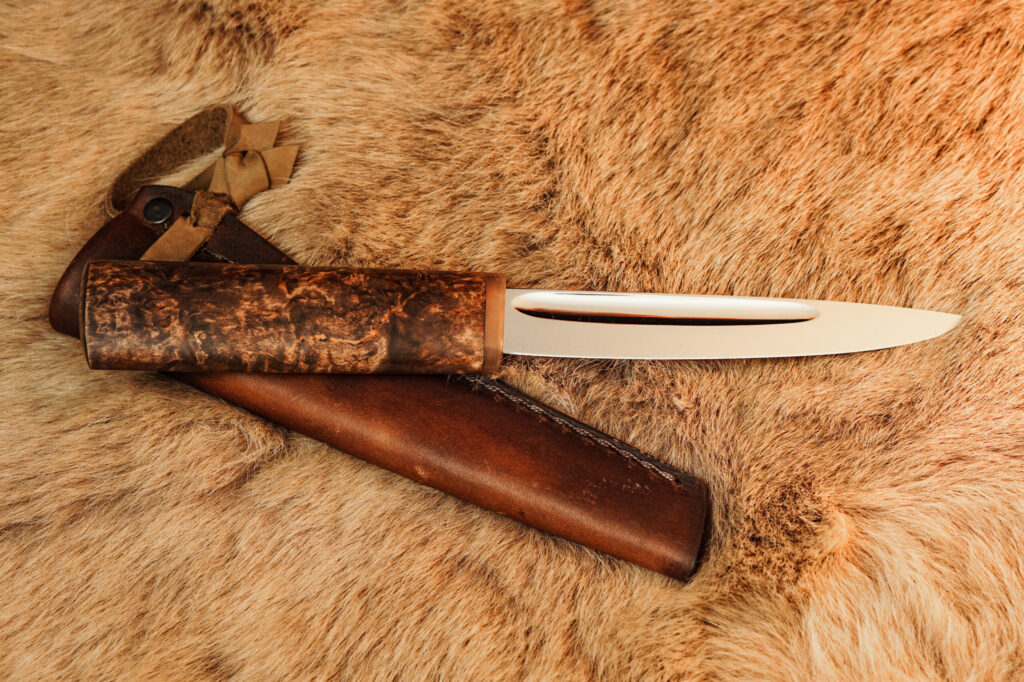
A Yakut knife and a Finnish puukko look like cousins — both are compact, guardless, birch-handled northern knives built around the idea of one knife for everything. The decisive difference is the grind. A puukko (and a Swedish Mora) uses a symmetric Scandi grind: a single flat bevel mirrored on both sides. A Yakut knife uses an asymmetric grind: convex on one face, flat with a hollow (dol) on the other. That one structural choice changes how each knife cuts cold, dense material — and which one is “better” depends on what you cut.
Yakut knife vs. puukko: what actually differs?
Both come from sub-arctic cultures that needed a single dependable blade, so they share a lot: moderate length, no finger guard, a warm natural handle, a sheath the knife sits deep in. The split is geometry. The puukko’s symmetric Scandi grind is simple to sharpen and excellent for woodwork — it bites into wood and takes clean, controlled shavings, which is why carvers like it. The Yakut’s asymmetric blade is tuned instead for frozen and sticky material: the hollow breaks suction, so frozen fish, fat and meat release cleanly instead of dragging on the steel. Put simply: a puukko is built around wood, a Yakut knife around cold butchery and food — though both handle the full range competently.
Yakut knife vs. Mora: handmade vs. mass-made
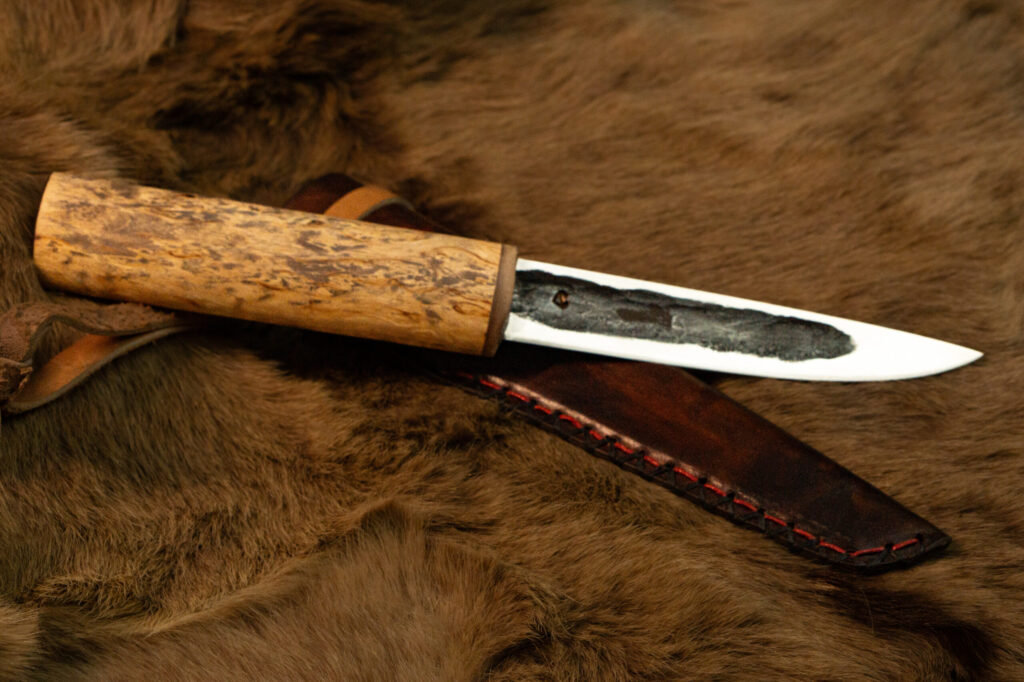
A Swedish Mora is the reference budget bushcraft knife — ground and assembled in a factory and sold at a budget price, with a consistent Scandi edge and a plastic or birch handle. It is genuinely good value. But every unit is identical, and the steel and fit are set by a production line. A Yakut knife sits at the opposite end. It is hand-forged and hand-fitted by one smith, so the forge marks, the depth of the dol and the figure of the birch handle differ from piece to piece. It costs several times more. Choose a Mora if you want a knife to abuse on a budget; choose a Yakut knife if you want one made by a person, with a grind built for the cold.
Yakut knife vs. modern full-tang bushcraft knives
Most Western “bushcraft” knives today are full-tang drop-points — a slab of stainless or tool steel running the length of the handle, with synthetic scales bolted on. That construction is tough and abuse-tolerant, which is its whole point: batoning, prying, hard camp use. A traditional Yakut knife has a hidden tang seated in a wooden handle, is lighter in the hand and built for controlled cutting rather than crowbar work. It also brings a guardless, slightly bulbous handle you can hold securely with cold or gloved hands, and a grind made for −50 °C Yakutia. If your use is heavy batoning, a full-tang knife is the safer pick. If it’s hunting, fishing, food and everyday cutting in the cold, the Yakut geometry was made for it.
Quick comparison
| Yakut knife | Puukko | Mora | Modern bushcraft | |
|---|---|---|---|---|
| Grind | Asymmetric: convex on one side, flat with a dol on the other | Symmetric Scandi | Symmetric Scandi | Symmetric Scandi, flat or convex |
| Sharpening | Flat side whole on the stone; no bevel on the convex side, burr off on a strop | Scandi bevel flat on the stone, both sides | Scandi bevel flat on the stone, both sides | Same angle on both sides |
| Blade length | Small 9–12 cm, large 15–17 cm; stroganina knife 19–22 cm | Short, typically 8–12 cm | About 10 cm on the common models | Usually 10–13 cm |
| Steel | 40Kh13 (stainless), Kh12MF (semi-stainless) or 65G (carbon) | Carbon or stainless | Carbon or stainless | Stainless or tool steel |
| Construction | Hand-forged, hidden tang | Hand or factory, hidden tang | Factory, partial/stick tang | Factory, usually full-tang |
| Handle | Birch burl or Karelian birch, no guard | Birch, no guard | Birch or polymer | Synthetic scales |
| Best at | Frozen meat/fish, hunting, food | Woodwork, carving | Budget all-round | Hard use, batoning |
| Each one unique? | Yes | Sometimes | No | No |
| Price | Several times a Mora; Damascus and signature pieces more (current prices) | Mid; handmade costs more | Budget | Mid to premium |
Which should you buy?
Buy a puukko or Mora if your priority is woodcraft and carving, or you want a cheap knife you won’t worry about. Buy a full-tang bushcraft knife if you plan to baton and pry hard. Buy a Yakut knife if most of your cutting is hunting, fishing and food — especially cold, dense material — and you want a knife forged by hand by one smith rather than a factory product.
Frequently asked questions
Is a Yakut knife better than a puukko?
Neither is universally better. A puukko’s symmetric Scandi grind excels at woodwork; a Yakut knife’s asymmetric grind with a dol excels at frozen meat, fish and food. Pick by your main use.
Can a Yakut knife do bushcraft and batoning?
It handles bushcraft and food prep very well. For heavy batoning and prying, a full-tang knife is more abuse-tolerant — a Yakut knife rewards controlled cutting, not crowbar work.
Why does a Yakut knife cost more than a Mora?
A Mora is factory-made and identical unit to unit; a Yakut knife is hand-forged and hand-fitted by one smith, so no two are alike. A Mora is a budget knife; our Yakut knives cost several times more.
Is the asymmetric grind harder to sharpen?
No, but it’s different: the flat side with the dol goes whole on the stone, and the convex side gets no bevel — its burr comes off with light strop passes. See our guide to sharpening and caring for a Yakut knife.
Our knives are forged by hand by smiths of the Sakha Republic; MUUS brings their work to you from Yakutsk. Explore the collection »
Hand-forged Yakut knives from Sakha smiths
Forged by master smiths of the Sakha Republic; MUUS sells their work online and in our shop in Yakutsk — from working models to collector pieces.
Shop hunting knives