
Looking to buy one? In stock from $139. Shop Yakut knives →
Choosing a Yakut knife comes down to five decisions: which hand it’s ground for, how big a blade you need, which steel, the handle material, and which blade type in the family fits your use. Because every authentic Yakut knife is hand-forged, these aren’t marketing options — they change how the knife works for you. This guide walks each decision so your first knife is the right one.
Right-handed or left-handed?
This is the one decision you cannot get wrong. The Yakut blade is asymmetric, so it is handed: a right-handed knife has its hollow (dol) ground for a right-handed user, and a left-handed user holding it loses the clean-release benefit that defines the knife. The two are not interchangeable, the way a symmetric Scandi blade is. Most knives are right-handed. Left-handed ones exist but are few, and since every knife is one of a kind we can’t promise one in stock: look for models marked Left-Handed in the shop, or ask us in chat. Everything else on this page is a preference; this one is a fit requirement.

What blade length do you need?
Match length to your main task, not to “bigger is better.” A small knife (9–12 cm blade) gives the most control for food prep, fishing, fine cutting and everyday carry — the most versatile choice, and the one most first buyers should pick. A large knife (15–17 cm) suits hunting, butchering and camp work, where you want more reach. A stroganina knife (19–22 cm) is a separate tool — long and thin, for shaving frozen fish — not simply a bigger everyday knife. The exact blade length is on each product page.
Carbon steel or stainless?
Three steels cover most Yakut knives, and the choice is about care. 40Kh13 is stainless: it shrugs off fish, blood and acidic food and asks only for a wipe. Kh12MF is a semi-stainless tool steel: it holds an edge longer and rusts more slowly than carbon steel, but can spot if you put it away wet. 65G is a carbon spring steel: it takes a keen edge and sharpens on almost anything, but it rusts and darkens — wipe it dry after every use and keep a thin film of oil on it. If this is your first knife and it will live around water, fish or the kitchen, 40Kh13 is the lower-stress choice. If you enjoy looking after a blade, 65G rewards you. There is no single best steel, and the grind matters more than the grade — see Yakut knife steel.
Which handle material?
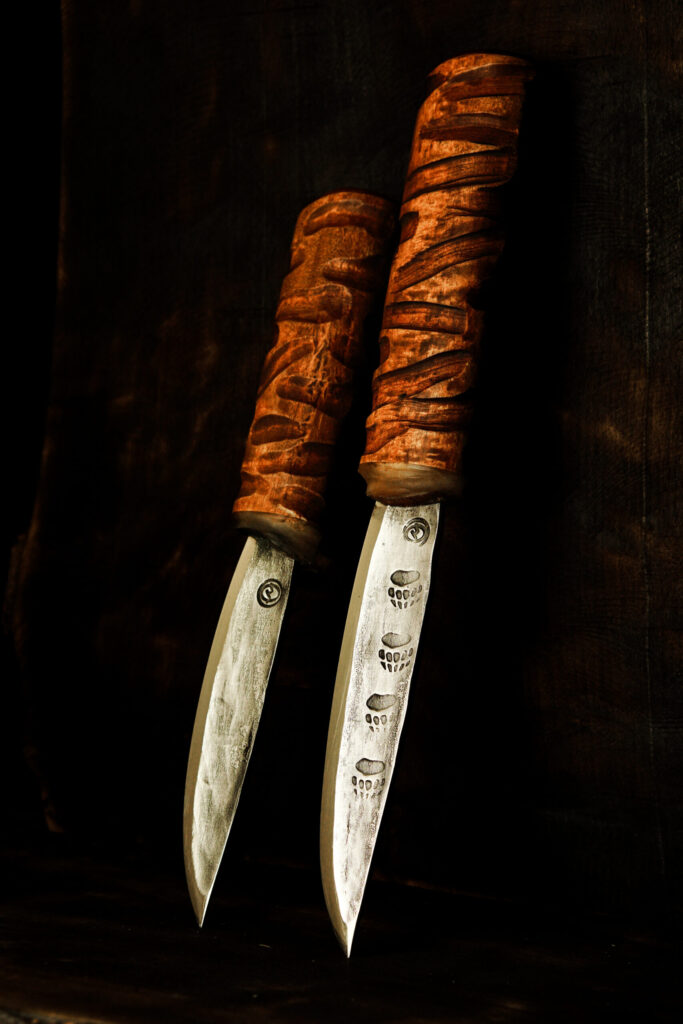
The classic handle is birch burl — a knotty growth whose figure never repeats. It is rare, so more knives now come with Karelian birch, which is denser and just as warm in the hand. Both are shaped without a guard, so you can hold the knife securely with cold or gloved hands. The bolster is mountain-ram horn or moose antler; bone is not used in a traditional Yakut handle. Handle choice is mostly about look and feel, so pick the one you’ll enjoy holding — and give the wood a little oil once or twice a year.
Yakut knife, hunting knife, Batas or Batyya?
| Blade | Best for | Size | Choose if |
|---|---|---|---|
| Yakut knife | Everyday, all-purpose | Standard | It’s your first or most-used knife |
| Hunting knife | Field dressing, heavy outdoor use | Heavier | You hunt or work outdoors hard |
| Batas | Heritage / display | Large, spear-form, on a shaft | A cultural or collector object |
| Batyya | Butchering, clearing, camp and household work | Machete / short-sword | Heavy taiga or household work, or a collector piece |
The family splits by job. The Yakut knife (byhakh) is the versatile everyday blade — start here. The hunting knife is the same design forged heavier for field-dressing and demanding outdoor work. The Batas is a spear-type blade on a shaft with deep cultural roots, bought mainly as a heritage or collector’s object. The Batyya is a long blade at machete/short-sword scale for butchering meat and fish, clearing, camp and household work. For a first knife you’ll actually use, the everyday Yakut knife or the hunting knife is almost always the right call.
A simple recommendation
If you want one answer: a Yakut knife in stainless 40Kh13 with a birch handle, ground for your dominant hand — small (9–12 cm) if it’s mostly for food and everyday cutting, large (15–17 cm) if it’s mostly for hunting. It’s the most forgiving, lowest-maintenance way into the tradition. Move to a carbon 65G blade, a stroganina knife or a Batyya once you know how you actually use it.
Frequently asked questions
What’s the best first Yakut knife?
An everyday Yakut knife in stainless 40Kh13 with a birch handle, ground for your dominant hand: a 9–12 cm blade for food and everyday use, 15–17 cm for hunting. It’s versatile and low-maintenance.
Does a Yakut knife come ready to use?
Yes — it ships sharp, in a fitted sheath. You only need basic care: wipe it dry after use and oil the blade now and then (a 65G blade after every use).
Is carbon or stainless better for a Yakut knife?
Neither is better — they need different care. Stainless 40Kh13 is the low-maintenance choice around water and food. Carbon 65G sharpens most easily but rusts and darkens, so it must be wiped dry and oiled. Semi-stainless Kh12MF sits between them and holds an edge longest.
How do I make sure I get the right-handed version?
Check the product page: left-handed models are marked Left-Handed, the rest are right-handed. If you’re unsure, ask us in chat before you order. The asymmetric grind is handed, so matching it to your hand matters — see the pillar guide for why.
Every knife in our shop is hand-forged by a smith of the Sakha Republic and ships with the maker’s certificate naming the model and confirming it is a utility knife under Russian standard GOST R 51644 (not a weapon). Browse all knives »
Hand-forged Yakut knives from Sakha smiths
Forged by master smiths of the Sakha Republic; MUUS sells their work online and in our shop in Yakutsk — from working models to collector pieces.
Shop Yakut knives