
An authentic Yakut knife is hand-forged in Yakutia with an asymmetric blade: a hollow (dol) ground into one face only, a flat or convex other side. A growing number of listings sell factory-stamped “Yakut-style” knives that copy the silhouette but not the geometry or the hand-work. This guide gives you a concrete checklist — what to look at, what to ask a seller, and the red flags that give a fake away.
What defines an authentic Yakut knife?
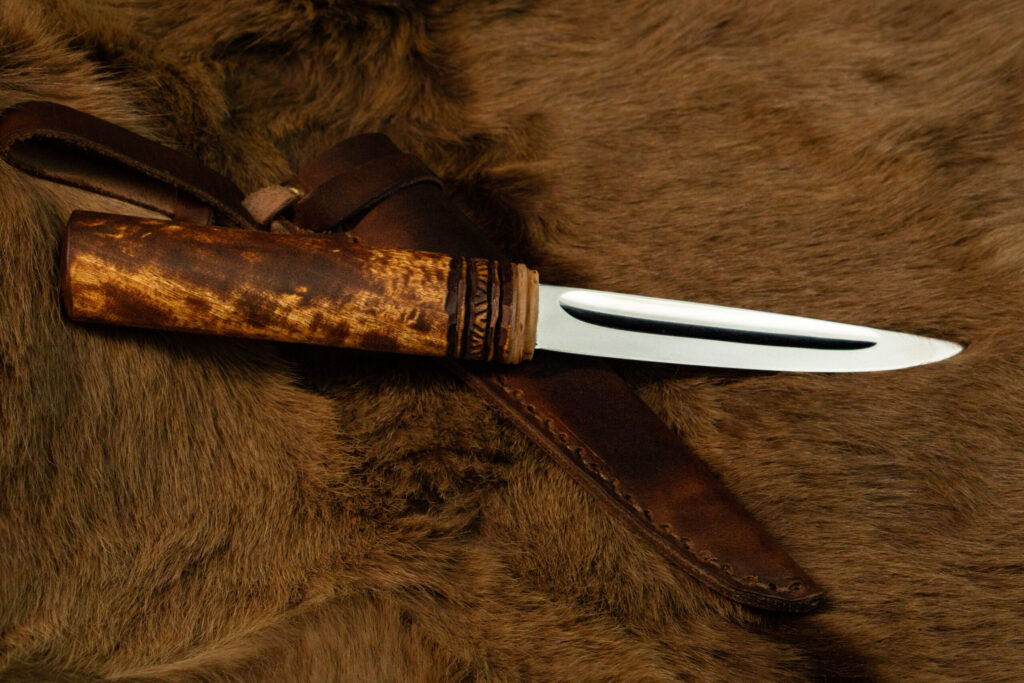
Two things: the grind and the making. The blade must be asymmetric — a wide, shallow hollow (dol) on ONE face only, with the other face flat or slightly convex, tapering to the edge. That geometry is what makes the knife release frozen fish and meat cleanly, and it is “handed”: ground for a right- or left-handed user. And the knife must be hand-forged — shaped by a smith, not stamped from sheet steel. The traditional handle is Karelian birch or birch burl, egg-shaped in cross-section, fitted without a guard; the bolster, when present, is mountain-ram horn or moose antler — bone is not used in the authentic tradition. The sheath is leather, sometimes authentic bull-tail leather shrunk over a wooden core. (Full anatomy in What Is a Yakut Knife.)
How can you tell a real Yakut knife from a fake?
Run this checklist before you pay:
- One hollow, one side. Look at both faces: an authentic blade has the dol on one face ONLY. Symmetric blades — or “fullers” on both sides — are not Yakut geometry, whatever the listing says.
- Handedness stated. A real seller can tell you whether the grind is right- or left-handed. A listing that never mentions it usually isn’t selling a true asymmetric blade.
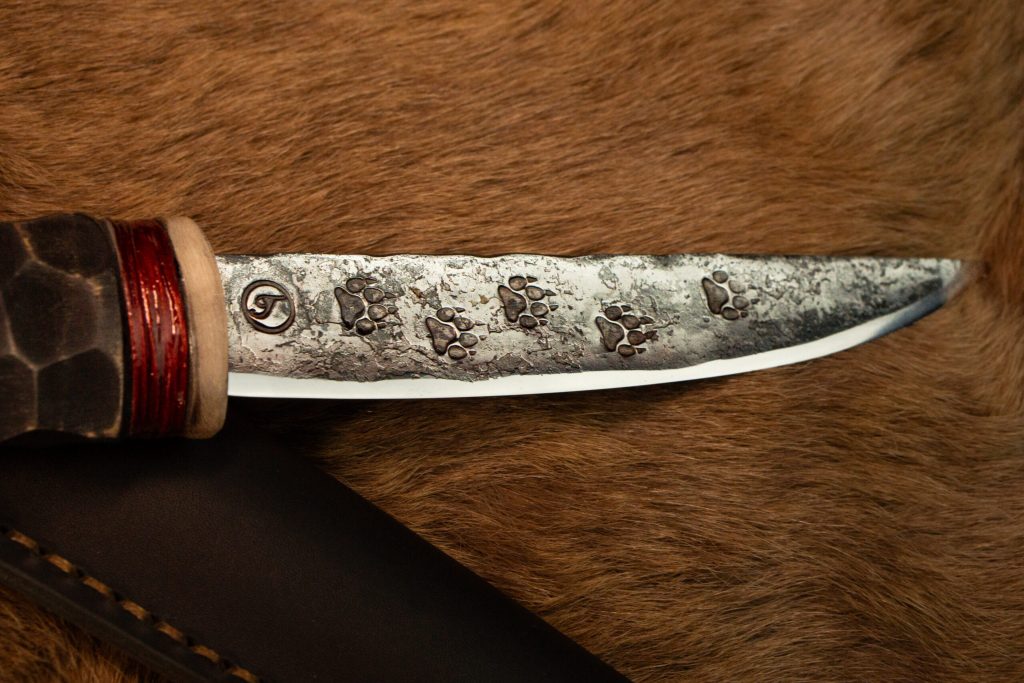
- Hand-forge character. Slight irregularities of a forged blade — the temper line, hammer texture near the spine — are normal. Ten identical mirror-finish blades in one photo means a production line.
- Natural materials. Karelian birch or birch burl handle (grain visible, no two alike), horn or antler bolster, leather sheath. Plastic handles, bolted synthetic scales, or “bone” handles marketed as traditional are red flags.
- Origin and maker. Authentic knives come from Yakutia (the Sakha Republic), and each blade is one smith’s work — many carry the maker’s stamp. A reputable seller can tell you where its knives are made and which smiths it works with, and sends paperwork with the knife.
- Price reality. Hand-forging takes a smith’s day, not a machine’s minute. A bargain-priced “Yakut knife” is a factory copy.
Common red flags in marketplace listings
The most frequent fakes are easy to spot once you know the tells: “Yakut-style” wording (an honest admission it is not the real thing); stock photos repeated across many sellers; a symmetric Scandi grind described as “Yakut”; stainless blanks with a machined groove imitating the dol but ground on both sides or too narrow to matter; no mention of Yakutia, the smith, steel grade, or handedness; and prices far below the cost of hand work. None of these makes a knife bad as such — a factory knife can cut — but it is not an authentic Yakut knife, and it will not behave like one on frozen material.
What should you ask the seller?
Four questions separate real dealers from resellers in one message: Where was this knife made? (expect Yakutia and a seller who can name smiths it works with — a maker’s stamp on some blades — not silence); Is the grind right- or left-handed? (expect the seller to state the hand; if you need the other one, the choice is among models marked left-handed, where the seller has them); What steel and handle material is this exactly? (expect specifics — e.g. 40Kh13, Kh12MF or 65G steel, Karelian birch or burl — not “high quality steel”); and What paperwork comes with it? (expect a document naming the model, not a shrug). A seller who answers all four without hedging is almost always selling the real thing. Where MUUS knives come from is on Why MUUS.
Frequently asked questions
How can I tell if a Yakut knife is real?
Check the grind first: an authentic blade has a hollow (dol) on one face only and is ground for a specific hand. Then check materials (Karelian birch or burl handle, horn bolster, leather sheath), origin (forged in Yakutia, from a seller who can say where and by whom), and price (a bargain-priced knife is a factory copy).
Are cheap “Yakut knives” on marketplaces authentic?
Almost never. Bargain-priced listings are factory-made copies — usually a symmetric grind with a decorative groove, uniform from unit to unit. They can be usable knives, but they are not hand-forged Yakut knives and lack the asymmetric geometry that defines one.
Does an authentic Yakut knife have a maker’s mark?
Not always — traditional smiths did not consistently mark blades, so a missing stamp proves nothing either way. Provenance matters more: Yakutian origin, a seller who can say who makes its knives, and paperwork. Many MUUS blades carry the smith’s stamp, and each knife ships with the maker’s certificate naming the model and confirming it is a utility knife under Russian standard GOST R 51644 (not a weapon).
What does a real Yakut knife cost?
Far more than a factory copy: the price depends on size, steel and handle material. At MUUS, the price of each knife is on its page; Damascus and signature pieces cost more — see current prices in the shop. If the price looks too good for a day of a smith’s work, it is.
Forged by smiths in Yakutia; MUUS brings their work to you from our shop in Yakutsk. Browse the collection »
Hand-forged Yakut knives from Sakha smiths
Forged by master smiths of the Sakha Republic; MUUS sells their work online and in our shop in Yakutsk — from working models to collector pieces.
Shop Yakut knives