Short answer: yes, in the countries we ship to most. A Yakut knife is a fixed-blade knife — no spring, no lock, no automatic opening — and fixed blades are not restricted at import in the USA, the UK, the EU, Canada or Australia. What those countries restrict are automatic knives (switchblades, gravity knives, ballistic knives), and we do not sell any. The rules that will actually affect you are about carrying a knife in public, not about owning or receiving one.
This page is general information from a shop that ships knives internationally every week — not legal advice. Rules change and vary by state, province and city; the two-minute check on your own jurisdiction is worth doing before you order.
What is a Yakut knife, legally speaking?
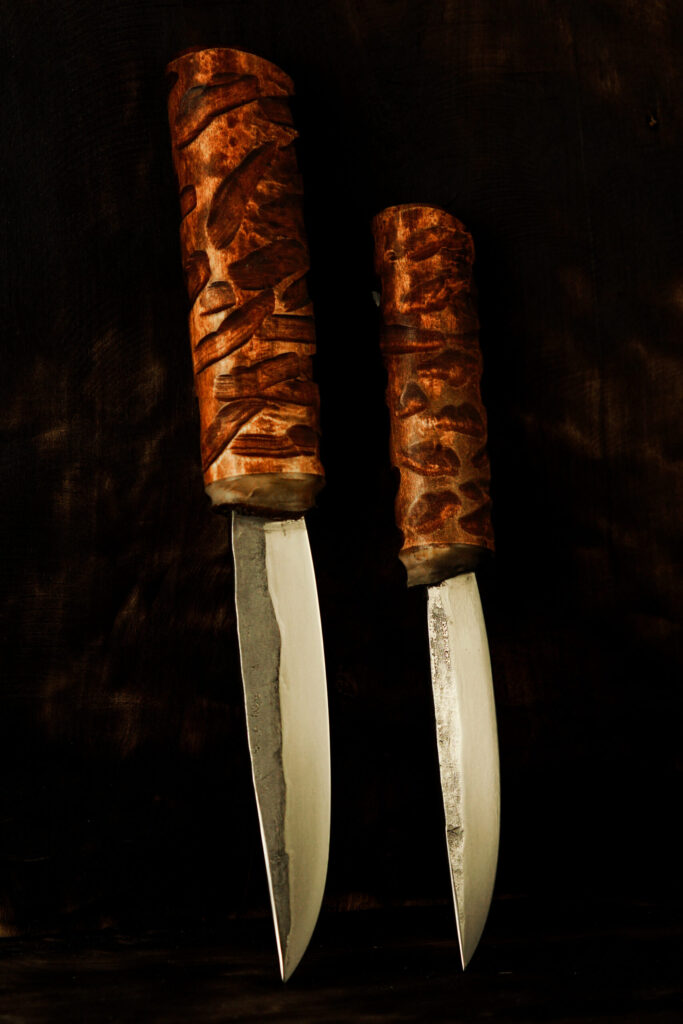
Legally it sits in the same category as a hunting, fishing or bushcraft knife: a fixed blade with a stick tang, a wooden handle and a leather sheath. It has no folding mechanism, no lock, no spring and no button — the features that trigger import bans in most countries. Our Yakut knives come in three sizes: small, with a blade of about 9–12 cm; large, about 15–17 cm; and the stroganina knife, 19–22 cm. All of them are ordinary for an outdoor knife and above the UK’s three-inch carry line; the large and stroganina knives are also above Germany’s 12 cm line. The batyya is a different object — see below.
Is it legal to import a Yakut knife into the USA?
Yes. US federal law bans the importation of switchblade knives — the Switchblade Knife Act of 1958 (15 U.S.C. §§ 1241–1245), enforced by Customs and Border Protection under 19 CFR §§ 12.95–12.103. A fixed-blade knife with no opening mechanism is not in that category, and fixed-blade knives are imported into the United States routinely.
Two practical points. First, customs clearance is not the same as carry law: once the knife is yours, state and city rules govern where and how you may carry it, and those differ sharply between, say, Texas and New York City. Second, duties and taxes on a personal shipment are the buyer’s responsibility. They depend on your country and on where the goods come from, and we don’t estimate them — check with your customs authority or the carrier before you order.
What about the United Kingdom?
Importing and owning a fixed-blade knife is lawful; what the UK bans is a specific list — flick knives and gravity knives under the Restriction of Offensive Weapons Act 1959, plus later additions such as zombie-style blades. A Yakut knife is none of those.
Carrying is the part to know. Under section 139 of the Criminal Justice Act 1988 it is an offence to have an article with a blade or point in a public place without good reason; blades over three inches (about 7.6 cm) are the usual line. Every knife we sell is longer than that, so carrying one in public in the UK needs a genuine reason — work, sport, fishing, a hunting trip — exactly as it would for any outdoor knife. Buyers must be 18 or over.
And the European Union?
There is no EU-wide ban on importing fixed-blade knives; each member state writes its own carry rules, and the strictest common case is Germany. Under § 42a of the German Weapons Act (Waffengesetz), carrying a fixed-blade knife with a blade longer than 12 cm in public is prohibited without a legitimate interest — owning one, buying one and receiving one by post are not. Our small knives (9–12 cm) sit at or under that line; the large ones (15–17 cm) and the stroganina knife (19–22 cm) are over it, and a German customer buying one of those should plan to keep the knife for home, workshop, kitchen, hunting or fishing use rather than everyday carry.
Other member states follow the same pattern — restrictions on carrying, not on receiving. Check your own country’s rule before ordering if you intend to carry.
Canada and Australia
Canada. The prohibited category is knives that open automatically — by spring, gravity or centrifugal force (Criminal Code s. 84(1)). Fixed-blade knives are admissible; the Canada Border Services Agency may inspect the parcel, and it should be declared honestly as a handmade knife.
Australia. Import controls list specific weapons — flick knives, ballistic knives, daggers in some categories — under the Customs (Prohibited Imports) Regulations. A fixed-blade utility knife is generally admissible, but Australia is the jurisdiction where state law diverges most, and some states require a lawful excuse for possession in public. Check your state before ordering.
The batyya is a different question
The batyya is a large, long traditional Yakut blade on the scale of a machete or short sword — about 77 cm overall, not a pocket-sized object. Several countries treat blades of that length closer to a sword than to a knife, and some carriers handle them under different rules. We do ship it, but if you are ordering a batyya rather than a knife, check your national rules first — the answer that applies to a 130 mm blade does not automatically apply to a 77 cm one.
What is on the customs paperwork?
Every parcel leaves Yakutia by registered international post with tracking, declared for what it is: a handmade fixed-blade knife with a leather sheath. Each knife ships with the maker’s certificate naming the model and confirming it is a utility knife under Russian standard GOST R 51644 (not a weapon) — a useful thing to have if a customs officer asks. Import duties and taxes, where they apply, are paid by the buyer; they depend on your country and on the goods’ origin, and we don’t estimate them — your customs authority or the carrier can. Rates and transit times are on the shipping page.
Frequently asked questions
Will US customs seize a Yakut knife?
The federal import ban covers switchblades and similar automatic knives (15 U.S.C. §§ 1241–1245); a fixed-blade knife with no mechanism falls outside it. Declare the parcel accurately. One thing to know: a handle or bolster of moose antler or mountain-ram horn is an animal material, and for import into the USA such parts may need separate clearance under U.S. Fish and Wildlife Service rules (declaration Form 3-177). If that matters to you, ask us about a model without horn before you order. Duties are a separate question — see the shipping page.
Can I carry a Yakut knife in public?
That depends on where you live, and it is a different question from importing. In the UK a blade over three inches needs a good reason in public; in Germany the threshold is 12 cm; in the USA it varies by state and city. Our blades run from about 9 to 22 cm, so assume you need a legitimate reason — work, hunting, fishing, sport — rather than everyday carry.
Do I need a licence to own one?
No licence is required to own a fixed-blade knife in the USA, the UK, Germany, Canada or Australia. Age limits apply to the purchase — 18 and over in the UK and most of the EU.
What if my country does restrict it?
Tell us before you order. We ship internationally every week and we would rather not send a knife into a jurisdiction that will hold it — if the rules where you live make delivery doubtful, say so and we will look at it with you instead of guessing.
Ready to choose one? See how to choose a Yakut knife, or browse the knives we have in stock »
Hand-forged Yakut knives from Sakha smiths
Forged by master smiths of the Sakha Republic; MUUS sells their work online and in our shop in Yakutsk — from working models to collector pieces.
Shop Yakut knives