
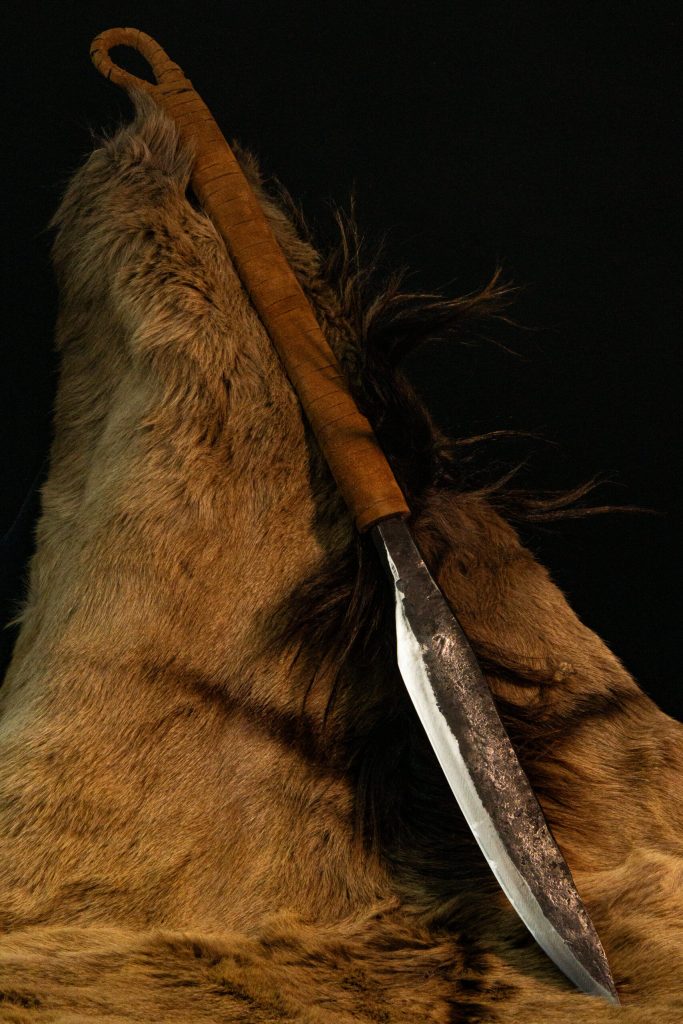
A batyya (also spelled batyia) is a large Yakut blade: long, broad and with an extended handle — closer in scale to a machete or a short sword than to a knife. It is a traditional Sakha working tool: used to butcher meat and fish, to clear a trail, and for heavy work at camp, in the taiga and around the household. Today smiths in Yakutia still forge the batyya as a traditional piece, and people buy it both to use and to collect.
What a batyya is
A batyya is held in the hand like a big knife: the blade is fixed to a handle, not to a long haft. The batyyas in our shop are about 77 cm long overall with a braided-leather handle, and are sold as household utility pieces for slicing fish and butchering meat. Next to the batyya in Sakha tradition stands the batas — a spear-type blade on a haft. “Palma” is the Russian name for such Siberian polearms — per Russian Wikipedia, a single-edged, knife-shaped head on a haft, used by the Sakha, the Evenki and other peoples of Siberia, and adopted in the 17th century by Russian servicemen as well.
Sizes differ from source to source, which is what you would expect of a tool each smith made to his own measure. The Yaroslavsky Yakut Museum of History and Culture (in Russian) describes the batyya blade as knife-shaped, up to 40 cm long, with a wide oval groove, and the handle as 30–50 cm. The blade was set into the handle by its tang and bound with sinew or leather.
What the Sakha used it for
Above all, it was a working tool. The museum calls the batyya an “everyday tool for travel and the household”: it went along on the hunt, chopped like an axe and was even used to cut grass. The handle gave what a knife cannot — leverage and reach — for lopping branches, cutting a path or breaking down a large carcass.
Sources mention combat and hunting use too: a study of warrior equipment in the Olonkho epic by A. Pakhomov and L. Efimova (in Russian) describes both the batyya and the batas as close-combat cutting and thrusting arms that were also used for hunting. In everyday life, though, the museum treats the batas on its long haft as the weapon and the large-game hunting piece, and the batyya as a tool.
Batyya vs batas
The Sakha had two large blades, and the museum tells them apart like this:
- Batyya — a knife-shaped blade up to 40 cm with a wide oval groove; a handle of 30–50 cm. An everyday working tool: butchering, household work, the taiga.
- Batas — a 50–70 cm blade that widens from the heel to the middle and narrows sharply to the point, with a thin, long groove near the spine; a haft of one and a half to two metres. In the past, a weapon and a hunting tool for large game.
Put simply, the batyya is shorter and broader, closer to a knife, and is worked in the hand; the batas is longer, on a haft, closer to a spear.
How it differs from a Yakut knife
A Yakut knife is a hand tool: a 9–17 cm blade (19–22 cm on a stroganina knife), a birch-burl handle and a sheath the knife sits in almost up to the middle of the handle. It is made for precise work — carving, skinning, slicing meat and fish.
The batyya works differently: bigger, heavier and with a long handle. Its job is to chop, butcher and clear where a knife has neither the length nor the mass. What they share is the groove on the blade — on the batyya, according to the museum, it is wide and oval. Around a camp they are not substitutes but a pair: the knife for fine work, the batyya for heavy work.
What a batyya looks like today
Old batyyas are kept in the museums of Yakutia, and new ones are forged by today’s smiths. The batyyas in our shop are about 77 cm long, forged from 65G steel, with an extended handle wrapped in braided leather, and come with a wooden sheath.
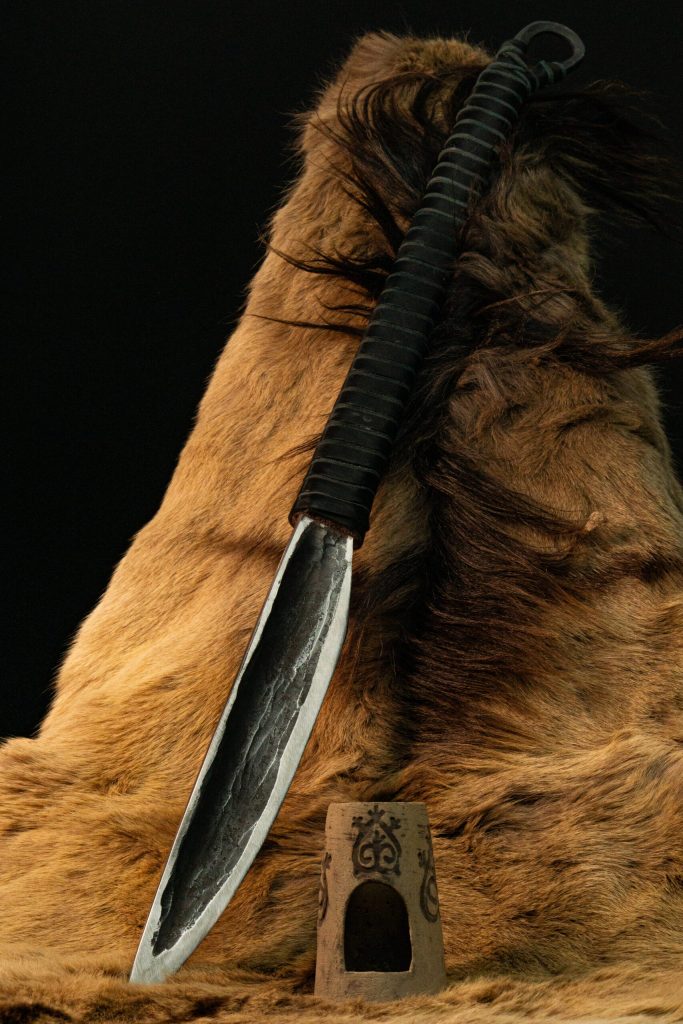
We list batyyas by Yakut smiths in the Batyya section. Each one is a single piece, and models appear there as they come in — ask in the chat what is available. If you need something for fine work, see the Yakut knife collection.
Frequently asked questions
How do you spell it: batyya, batyia or batiya?
All of these are transliterations of the same Yakut word, батыйа. We use “batyya” on this site.
Is a batyya the same as a palma?
Not quite. “Palma” is the Russian name for a Siberian knife-shaped head on a haft; among the Sakha the one on a haft was the batas, with a long blade and a haft of up to two metres. The batyya is a large blade with a handle — shorter and broader, worked in the hand.
Is Argys a batyya?
No. Argys is Yakut for “companion”, and in our shop it is the name of a Yakut knife — Faithful Companion — Argys, a hand-sized knife with a Karelian birch handle. It belongs to the Yakut knife family, not to the large blades like the batyya.
Is a batyya a weapon?
Historically, large Yakut blades were used both in battle and on the hunt, but the museum describes the batyya first of all as an everyday working tool. The batyyas in our shop are sold as utility pieces, and each ships with the maker’s certificate naming the model.
What is a batyya used for today?
Heavy work where a knife lacks length and mass: breaking down a large carcass or a big fish, lopping branches at camp, clearing ground in the taiga, household work. People also choose it as a piece of Sakha tradition and for a collection. For everyday cutting a Yakut knife is the better tool — see how to choose your first Yakut knife.
Hand-forged Yakut knives from Sakha smiths
Forged by master smiths of the Sakha Republic; MUUS sells their work online and in our shop in Yakutsk — from working models to collector pieces.
Shop the batyya